
Judging IT support by response speed alone leaves businesses exposed when disruptions hit. Support only protects your ability to trade if it is built around your business continuity plan.
Picture this: your main system goes down on a Monday morning. The phone gets answered in thirty seconds flat. Your business is still offline four hours later. That gap is what small business IT support gets wrong when it's measured on the wrong thing.
Speed answers the phone. It doesn't answer whether your business keeps trading while the problem gets fixed. A provider can hit every response-time target on their dashboard and still leave you staring at a dead system, because the metric they're chasing was never connected to the plan that keeps you working.
Fast replies matter. But they're only worth something when they sit inside a plan built to keep your business trading through the disruption, not just acknowledging it happened.
That's the real dividing line in small business IT support: reactive versus proactive. One answers calls. The other is built around what your business actually needs to stay open.

The real cost of downtime for small businesses
Downtime doesn't just annoy you - it stops you. The moment your systems go down, you lose the tools and data your business runs on, and that translates directly into lost sales, missed opportunities, and customers who don't wait around.
Small businesses feel this harder than larger ones. There's no spare team to absorb the gap, no backup department to carry the load while things get fixed. That's exactly why your support needs to understand how your business actually operates, not just how to reboot a server.
And if your provider only shows up once something's broken, you'll keep seeing the same problem resurface. Support that's worth paying for plans for what could go wrong before it does, and builds the response to keep you working when it does.
Why business continuity matters more than response times
Business continuity means your company keeps operating no matter what hits it - a plan for serving customers, reaching your data, and running your systems through an IT incident, not around one.
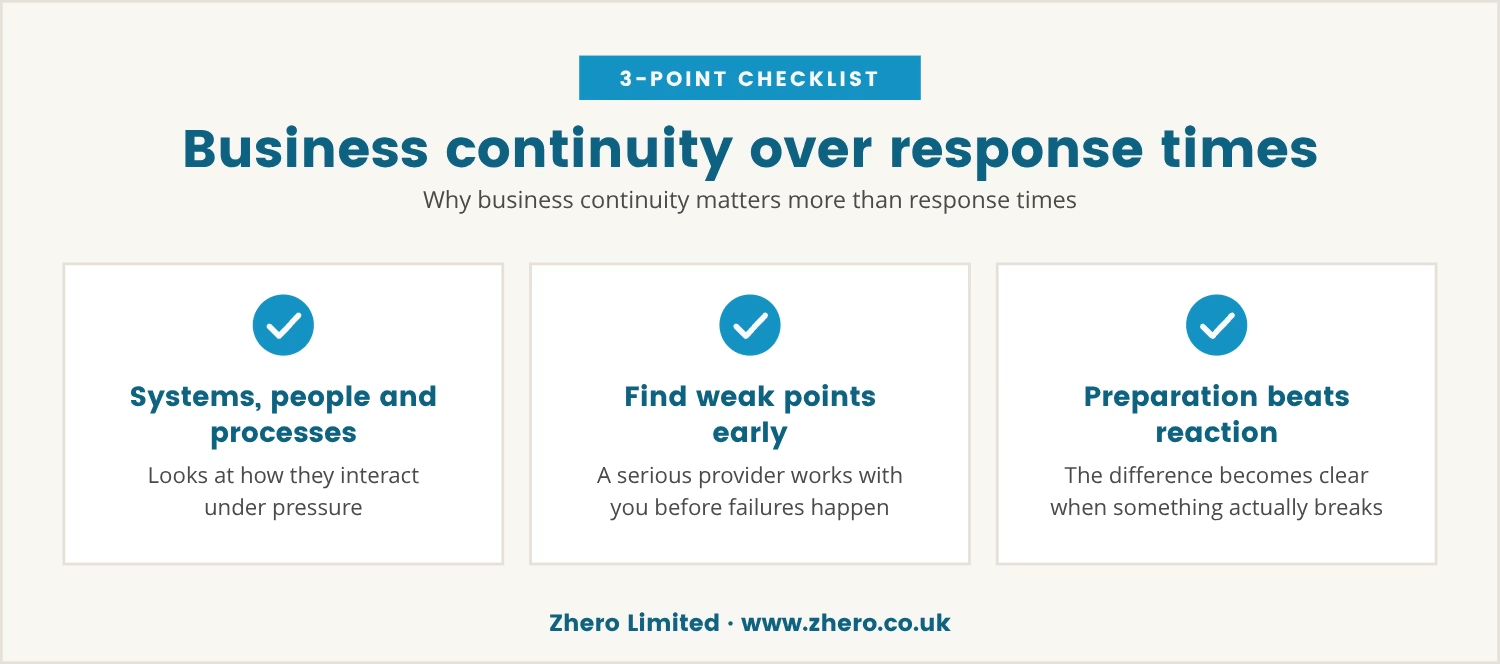
Tie your IT support to that plan and the whole job changes. It's no longer about answering the phone fast; it's about keeping the business running, which means looking at how your systems, your people and your processes actually interact under pressure.
A provider that takes continuity seriously works with you to find the weak points before they fail, not after. That's preparation, not reaction - and the difference shows the day something actually breaks.
Ask yourself how your business would cope if your main system failed right now. That answer is exactly what this kind of planning is for.
Small business IT support in London: What to look for
Finding support in London and Greater London means finding a provider who actually knows the local business environment - the compliance pressures, the cyber security exposure, and the reliability small and medium businesses in the area need day to day.
Look past the quick fix. A provider worth hiring helps you build a continuity plan, not just promise a fast pickup, and can explain exactly how their service maps to your business goals and keeps you trading when something goes wrong.
If all a provider talks about is helpdesk speed, that's a signal they're not thinking about your long-term needs. Ask instead how they support continuity and what experience they've got with businesses like yours.
Key elements of effective small business IT support
Technical skill alone doesn't make support effective. It takes understanding your business, planning for risk, and making sure you can keep working no matter what happens - and that breaks down into a few concrete pieces.
Understanding your business operations
Support providers need to learn how your business actually works - which systems matter most, which processes can't stop. That's what lets them plan around what counts.
Proactive risk assessment
A good provider looks for problems before they land, which means you're avoiding disruption instead of cleaning up after it.
Business continuity planning
Support should spell out clear steps for what happens when something goes wrong, so you keep trading straight through the incident.
Cyber security integration
Protecting your data and systems is part of keeping the business running, not a separate line item - security belongs inside the support plan itself.
Regular communication
Ongoing updates keep you prepared and able to make informed calls about your IT setup, rather than finding out about problems after they've already cost you something.
Tailored solutions
Your support should fit your business, not the other way round - a one-size-fits-all package gets you the wrong help at the wrong time.
What happens when support focuses only on response times
Measure support purely on how fast someone picks up, and the details that actually matter get missed. Quick responses handle small problems fine; they don't touch the bigger risks that can stop your business cold.
Leave your provider out of your continuity planning and you'll find out how unprepared you are exactly when it's least convenient - longer downtime, lost revenue, a dent in your reputation that outlasts the outage itself.
Worse, support that's disconnected from your actual business needs tends to produce the same issue twice, because nobody's fixing the root cause. That costs more than the service fee - it costs you the ability to grow and compete while you're busy firefighting.
How to choose the right support provider for your business
Choosing the right provider means looking past the promise of a fast response and asking what actually sits behind it. A few steps make that easier:
- Assess your business needs: Understand what systems and processes are most important to your operations.
- Check for business continuity planning: Ask providers how they help you keep working during disruptions, not just how quickly they respond.
- Look for proactive support: Choose a provider who offers regular risk assessments and advice, not just fixes.
- Evaluate their understanding of your industry: Providers with experience in your sector can offer more relevant support.
- Ask about cyber security: Make sure security is part of their support plan, not an afterthought.
- Review their communication style: Clear, regular updates are a sign of a provider who values your business.
We run one model, built on our own tools, with a minimum security framework every client has to meet - no custom-built exceptions, no picking and choosing which bits apply. That's probably the clearest way to say it: accept the standard or we're not the right fit, and we'd rather say that upfront than pretend otherwise.
The reasoning is fairly simple once you look at how risk actually works. A patchwork of one-off setups and inconsistent baselines is exactly where things slip through - the system is only as strong as its weakest, least-standardised corner.
A single baseline, applied the same way across every client, is what lets us actually stand behind the support we give, because we're not guessing at five different configurations at once.
That's not a claim that nothing will ever go wrong once you're on it - nobody can promise that, and we won't pretend we can. It's a baseline requirement for being taken on as a client in the first place, not a guarantee stapled onto the service afterward.
Why tying IT support to business continuity protects your future
Build your IT support around a continuity plan and you get more than peace of mind out of it - you cut the odds of downtime, protect your reputation, and give your business a real shot at growing instead of just surviving the next incident.
A provider focused on your long-term needs is preparing you for the unexpected, not just reacting to it - making sure your systems, your data and your people can keep working when problems actually show up.
That matters even more for small and medium businesses in London, where competition doesn't let up and customers expect reliability as standard. Tie your support to continuity and you're investing in where your company is headed, not just patching where it's broken today.

How Zhero Limited supports your business continuity
Most businesses with 5 to 40 users do not have the time or resources to plan for every IT disruption, and that is where Zhero Limited can help.
We invite you to see how our approach to IT support is built around your business continuity, not just fast responses. Let’s talk about what matters most to your business.
Ready to test support that keeps you trading?
Try our risk-free IT trial and receive a full cybersecurity audit at no cost, so you can see how support focused on business continuity works for your business.
Frequently asked questions
How can I make sure my IT support is helping my business grow?
Pick a provider who understands your business goals and advises on how technology can support growth, not just one who fixes what's already broken. They should be suggesting improvements before you have to ask.
What should I ask a support provider about their cyber security services?
Ask exactly how they protect your data, what security measures they run, and how they respond when a threat shows up. A provider worth hiring will explain their approach plainly and show how it sits inside your overall support plan.
Is it better to outsource IT support or keep it in-house?
Outsourcing gets you a wider range of skills and resources, often for less than a full in-house team costs. Still, the right answer depends on your business size, your needs, and your budget.
How do I know if my support provider is the right fit for my organisation?
Look for clear communication, real understanding of your industry, and a proactive approach to your needs. They should be able to explain exactly how their support fits your business and what they do to keep you operating.
What are the risks if my IT support only focuses on response times?
Support measured only on speed misses the planning for bigger risks entirely. That gap shows up as longer downtime, repeated issues, and lost productivity, because nobody's addressing why the problem happened in the first place.