Moving to advanced firewall features without a managed service can leave a business less secure than a basic setup that is actively maintained. Overspending on unused tools often means missing hidden risks. The real protection comes from regular management, not just more features.
Picture a business in London that's just had the newest next-generation firewall installed, confident the hardware alone will keep attackers out. That's the gap worth naming: managed firewall services only earn their keep when someone's actually watching the thing, day in, day out.
Next-generation features look sharp on a spec sheet, but they only work when someone's tuning alerts, patching rules and reading logs around the clock. Leave that chair empty and small gaps form quietly, invisible until something walks straight through them.
So the real value of any firewall sits less in its feature list and more in how consistently it gets reviewed and maintained. A setup nobody checks can leave you exposed even when every box on the brochure is ticked.

Next-generation features are not a guarantee
Plenty of businesses assume the newest firewall solution on the market will automatically harden their network. It doesn't work that way.
Next-generation firewalls ship with a long list of advanced threat detection tools, but each one is only as sharp as the person reading its alerts, checking its logs and adjusting its settings. Leave that seat empty and threats slip straight past the dashboard.
A basic firewall that's properly maintained - patched, configured with care, checked on a schedule - often holds up better than a complex system nobody's steering. That's the real risk hiding in this choice: paying for capability you never use, while the fundamentals that actually keep you safe go unchecked.
Why management matters more than features
A long features list is easy to be impressed by, but the strength behind managed firewall services sits in the service, not the spec sheet.
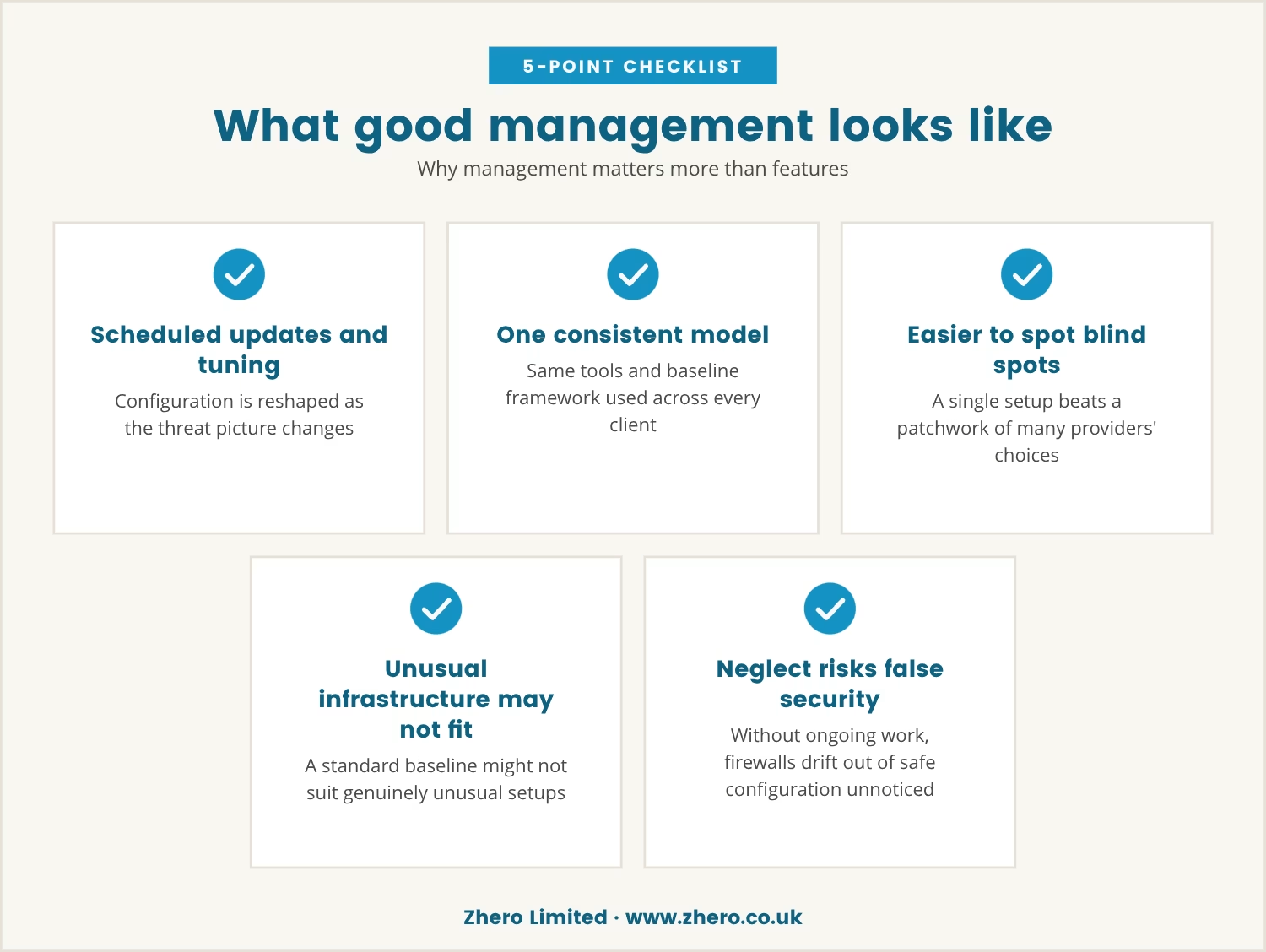
We don't stop at installing a box. We watch for unusual activity, push updates on a schedule, and reshape the configuration as the threat picture shifts - which is exactly why small issues get caught before they turn into real incidents.
We run one model across every client we work with - our own tools, our own baseline security framework. A single, consistent setup is easier to monitor for blind spots than a patchwork of twelve different providers' choices.
That's the instinct we hold onto: uniform tooling means our SOC and NOC know what normal looks like for every client, so an anomaly actually stands out instead of hiding in the noise.
We won't pretend that's beyond question - maybe a business running genuinely unusual infrastructure doesn't fit a standard baseline as neatly. But for most businesses, standardising the baseline is what makes proactive monitoring possible in the first place.
Skip that ongoing work and even a strong firewall drifts out of date or slips out of a safe configuration without anyone noticing. The business ends up with a false sense of security - protected on paper, exposed in practice.
Managed firewall services in London and Greater London
For businesses based in London and across Greater London, the decision carries an extra layer: regulations shift fast, and the threats hitting networks in this region keep evolving with them.
A managed firewall service built around that region keeps you compliant and keeps you covered against the kinds of threats most common locally. Local expertise also means someone can respond the moment something breaks, which keeps downtime and losses down.
The real risks of unmonitored advanced firewalls
Buy next-generation firewalls without a managed service wrapped around them, and several risks show up at once:
- Unnoticed configuration errors: advanced features often need complex setup, and mistakes can leave open doors for attackers.
- Missed updates: without regular updates, even the best firewall loses effectiveness over time.
- Alert fatigue: too many alerts with no one to review them means real threats get ignored.
- Budget waste: paying for features that go unused or misunderstood doesn't improve security.
- Compliance gaps: missing regulatory requirements can mean fines and reputational damage.
How a managed service provider adds value
A managed service provider brings expertise and consistency to your network security, and it breaks down into a few distinct jobs.
Continuous monitoring
We watch your firewall non-stop, catching malicious activity and unusual patterns as they surface. That's the job our own SOC and NOC exist to do, with a zero-wait SLA behind it.
Regular updates
We push firmware and rule updates on a set schedule, closing gaps before attackers get the chance to use them.
Expert configuration
We configure the firewall against your actual business rather than a generic template, cutting the unnecessary exposure that comes with a one-size-fits-all setup.
Fast response
When something goes wrong, we act immediately to contain and fix it - which is the whole point of running our own service desk with zero-wait response instead of a queue.
Compliance support
We keep the records and adjust settings as rules shift, covering everything from GDPR compliance to Cyber Essentials, so audits don't turn into a scramble.
Clear reporting
You get regular reports showing what's actually happening on your network and where the gaps still sit, so you're never guessing at your own exposure.
When a basic setup is better than unused advanced features
A simple firewall, managed properly, can protect you more than a complex system nobody keeps up with. What matters isn't the feature count - it's how much of it actually gets used.
For most small and medium businesses, nailing the basics - solid configuration, regular updates, active monitoring - beats chasing the newest technology on the market.
Ask yourself: do you have the time and the in-house expertise to run a next-generation firewall properly, or would handing that work to a managed service actually buy you more peace of mind?
Overspending and overlooked gaps: The hidden cost
Reaching for the most advanced firewall solution available is tempting, but without the management behind it, that choice leaves you overspending and under-protected at the same time.
Money spent on features nobody monitors or updates is money gone. Worse, it manufactures a false sense of security - the gaps sit there unnoticed until an incident forces the issue.
A reliable system under active management is, in the end, the safer and the cheaper option. What's worth paying for is what's actually being used and maintained, not what reads well on a spec sheet.

Why a managed approach makes sense for smaller teams
Many businesses with 5 to 40 users find themselves managing complex firewalls without the time or resources to keep everything up to date. At Zhero Limited, we understand how easy it is to end up with features that are not fully used or maintained.
If you want to see how we approach firewall management or want a second opinion on your current setup, we invite you to start a conversation with our team.
See where your security gaps really are
Get a risk-free IT trial and a free full cybersecurity audit to find out where your defences stand and what can be improved.
Frequently asked questions
How do I know if my firewall is being managed properly?
Check for regular updates, someone actually reviewing the security logs, and reports landing in your inbox about what's happening on your network. If none of that is happening, ask your provider to spell out their management process.
What is the difference between a managed firewall service and doing it in-house?
A managed firewall service means a third-party team handles the monitoring, the updates and the troubleshooting for you. In-house means your own staff carry that load, which gets hard fast for a smaller team without dedicated IT resources.
Can managed firewall solutions help with compliance?
Yes - managed firewall solutions usually include support for compliance, keeping records, applying the required settings and adjusting as regulations change. That makes audits and reporting far less painful.
Is it possible to outsource only part of my network security?
Yes, you can outsource one piece - firewall management, say - while keeping everything else in-house. That hybrid approach lets you put your own resources where they're actually needed most.
How often should firewall configuration be reviewed?
At least quarterly, and whenever your network setup changes or you add new services. Regular reviews catch errors early and keep the protection solid.