The first sign of weak cybersecurity in a startup is often a drop in customer support quality, not a direct breach. Businesses that treat support complaints as staffing issues risk missing hidden security problems until they escalate.
Weak cybersecurity in a startup almost never announces itself as a breach. It shows up first as friction - logins that stall, tools that behave unpredictably, tickets that pile up - all inside the support queue, long before anyone traces the fault back to security.
Startups in London and Greater London raised a total of $4.7B across 268 companies, with an average of $21M each and a median of $6.1M. That kind of money raises expectations for operations that run without a hitch, and support is usually where the first gap between expectation and reality shows up.
Picture IT support startups and you probably picture engineers shipping features, not a backlog of complaint tickets.
But the queue is where the fracture surfaces first: the earliest warning of weak cybersecurity in a startup is often not a data breach, but a sudden dip in the quality or speed of customer support. Once you see why that link exists, you can catch the risk early instead of after it's cost you something.

How customer support becomes the first casualty
Poor cybersecurity doesn't look technical from where your customers sit - it looks like bad service. When the systems behind your support desk are insecure, they tend to be unstable too, and instability means outages, sluggish response times, and tools that misbehave for no reason anyone's flagged yet.
Customers hit that instability before anyone connects it to security. Support staff get locked out of key systems or run into errors they can't explain, which makes it harder to close a ticket on the first try. Complaints climb, and the quality of support slides along with them.
Treat those complaints as a staffing or training problem and you'll miss what's actually going on. The fault usually sits further back, in gaps in cybersecurity for startups that nobody's gone looking for yet.
The hidden link between cybersecurity and customer support
Cybersecurity and customer support look like separate departments, but they're running on the same plumbing, so a crack in one tends to show up as a leak in the other.
When a startup's defences are weak, attackers can exploit the gaps to disrupt a service without ever touching the data inside it. Systems slow down or drop offline, and support is left explaining delays it didn't cause and can't easily account for.
Security tooling can make this worse on its own: automated protections sometimes lock out legitimate staff or customers by mistake, and now support has to verify identities and restore access on top of its normal workload. The process feels slow and unreliable because, operationally, it is.
Treat each complaint as an isolated incident and the cybersecurity gap underneath it stays invisible. Connect the two early, and there's a real chance to fix the actual issue before it escalates.
IT support startups: Why early warning signs matter
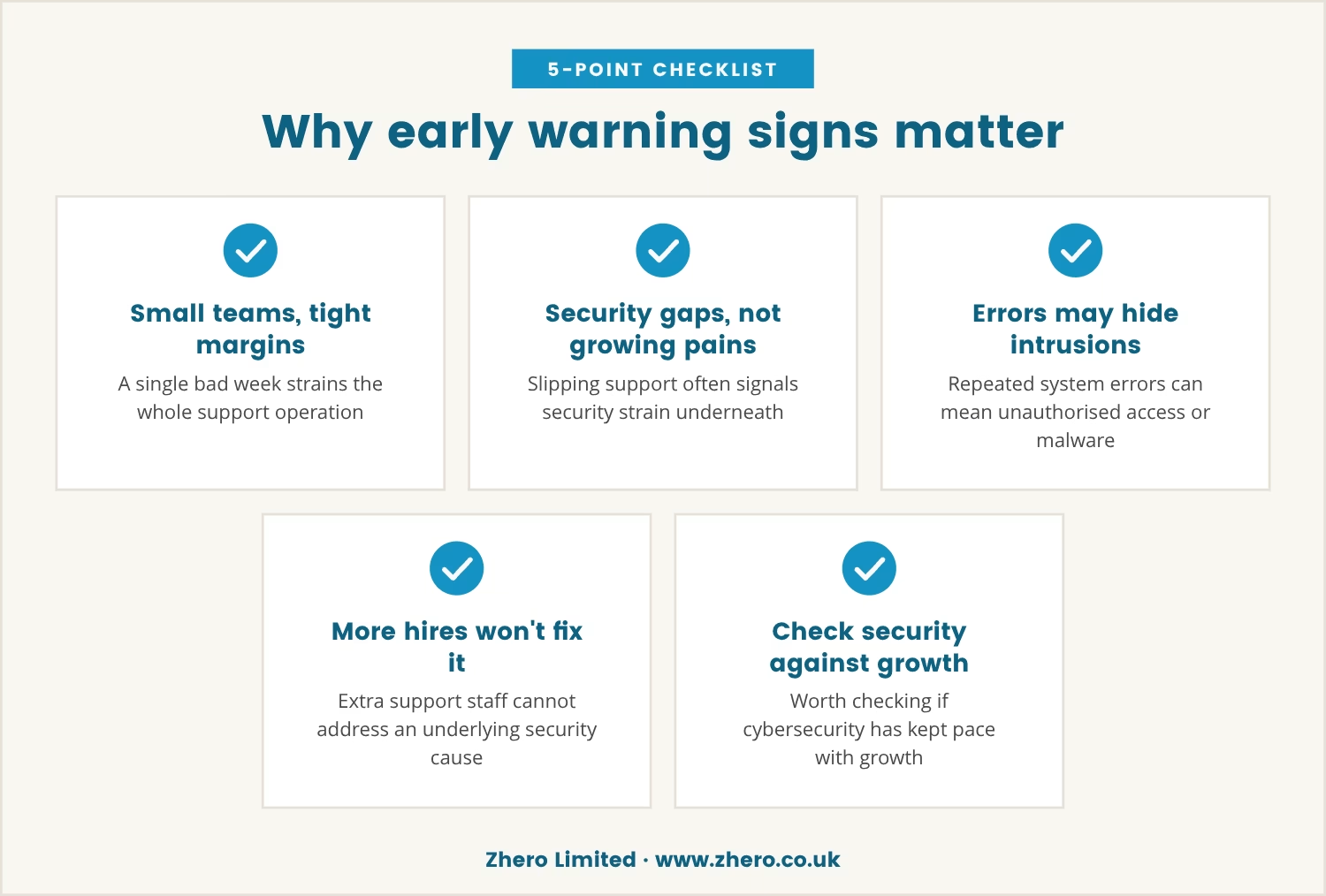
Startups tend to run support with small teams on tight budgets, so one bad week puts visible strain on the whole operation.
When support starts to slip, it's easy to blame staffing shortages or growing pains. But for IT support startups, that slip is often the first sign that security gaps are putting strain on the systems underneath.
Support staff suddenly unable to pull up customer records, or hitting the same system error repeatedly, can mean unauthorised access attempts or malware rather than a bad patch of luck. That slows support down and frustrates customers, while pointing at something deeper at the same time.
Hiring more support staff won't touch the root cause if that's what's happening. The thing worth checking is whether your cybersecurity practices have kept pace with how fast the business has grown.
What happens when startups ignore the warning signs
Ignoring early signs of trouble in customer support carries real cost, and the fallout tends to follow a fairly predictable sequence once it starts.
- Escalating complaints: Customers lose patience with slow or unreliable support, which turns into negative reviews and a damaged reputation.
- Staff burnout: Support teams absorb constant pressure, which drives turnover and loses valuable institutional knowledge.
- Operational bottlenecks: Frequent outages or errors slow down workflows and make it harder to scale seamlessly.
- Missed security breaches: Watching only support metrics means a real cyberattack can go unnoticed until it's too late.
- Lost business: As trust erodes, customers drift to competitors offering steadier service.
Each of these starts small, but for a startup still establishing itself, small problems compound fast.
How to spot technical issues behind support complaints
Spotting a technical or security problem inside a wave of support complaints takes a specific kind of attention, not just more hands on the queue.
Look for patterns in support tickets
When several customers report the same thing - lockouts, slow responses, the same error - that pattern points to a technical fault rather than a training gap. One-off complaints are noise; repeated ones are a signal worth following.
Check for system alerts or unusual activity
Frequent alerts about failed logins, slowdowns or unexpected downtime often flag a security issue before support even notices the pattern. A cluster of alerts is worth investigating on its own, not filed away as background noise.
Review access logs and permissions
Unexpected changes to who can reach sensitive data or systems can signal unauthorised activity. Checking permissions on a regular schedule catches that shift while it's still small.
Involve IT and cybersecurity teams early
When support problems persist, bring in technical specialists rather than more support headcount. They can confirm whether the root cause sits in cybersecurity startups or in infrastructure more broadly.
Communicate clearly with your support team
Encourage staff to flag recurring technical issues, not just customer complaints, since their day-to-day view often catches patterns no dashboard shows. That insight is frequently the fastest route to the real cause.
The role of managed IT service in preventing support breakdowns
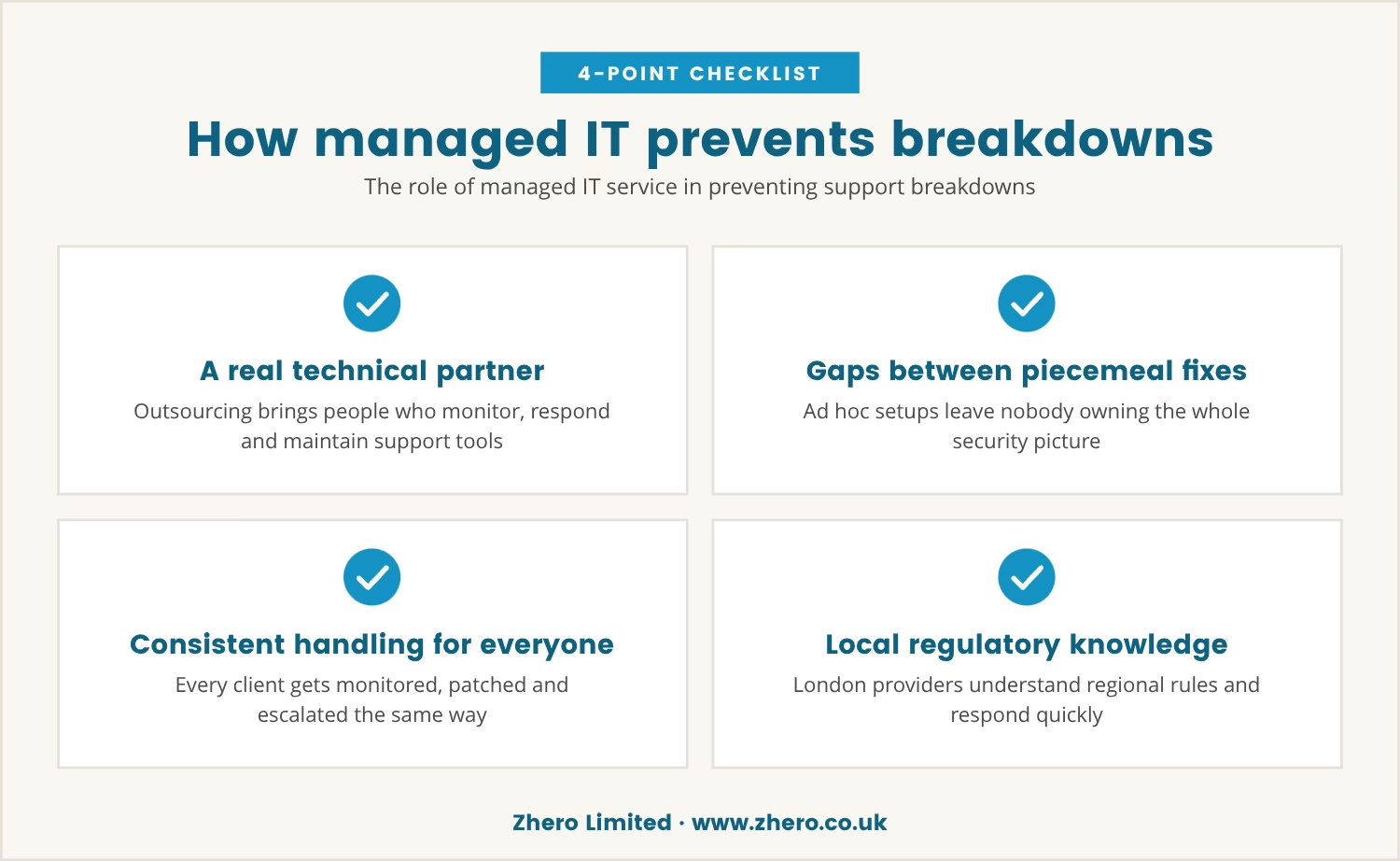
A managed IT service gives startups trying to avoid this pattern an actual technical partner: outsourcing some or all of your IT management gets you people who monitor systems, respond to threats, and keep support tools running, instead of leaving it to whoever's free.
We run this one way: our own tools, our own monitoring, a minimum security framework every client sits on top of.
We think that's the only way to actually hold a baseline across different businesses - skip the foundation and a setup tends to fail in the same place every time, so a business either accepts that model or it isn't really the right fit for us.
Ad hoc, piecemeal security setups - one tool bolted on here, a policy written for one client and ignored for the next - tend to miss the same thing every time: nobody owns the whole picture, so gaps sit between the pieces until something exploits them.
A standard minimum framework closes that gap, because every client gets monitored, patched and escalated the same way, not however the last contract happened to specify it.
For startups in London and Greater London, working with a local managed IT support provider means working with people who understand the regional regulatory context and can respond quickly when something goes wrong.
Scaling your business without sacrificing security
Growth pulls attention toward new customers and new features, but it pulls at your IT and support setup just as hard, and not always in a way anyone's budgeted for.
Every new tool, every AI integration, every added support hire opens a fresh surface that needs securing and watching, and nobody notices the gap until something uses it.
To scale without the security cracking, build it into the workflow from day one: regular audits, a clear onboarding process for new staff, and ongoing training so the team keeps pace with current threats rather than last year's.
When to act: Turning support complaints into security improvements
Support complaints aren't always what they look like on the surface, and that's the thing worth holding onto. If your startup starts hearing more about slow responses or dropped tickets, it's worth checking deeper rather than just hiring to the queue.
Treat those complaints as a possible signal of a technical or security issue, and there's a real window to act before a minor problem turns into a major one - one that protects your reputation, keeps your team from burning out, and lets the business grow on steadier ground.

Spotting the real cause before it grows
Most startups with 5 to 40 users rely on every team member to keep things running smoothly, but it’s easy to miss the warning signs when support slows down. At Zhero Limited, we understand how quickly a minor issue can become a major disruption if the root cause is overlooked.
If you want to see how we approach these challenges, or just want to talk through your own setup, we’re ready to help you look deeper.
Worried about support issues hiding bigger risks?
You can try our IT services risk-free and get a full cybersecurity audit at no cost, so you can uncover hidden problems before they grow.
Frequently asked questions
How can a startup know if customer support issues are really technical problems?
Track what the complaints actually say: several customers reporting the same lockout or the same slow response points to a technical or security fault rather than a one-off support error. System logs and a quick check from IT will usually confirm which it is.
What is the benefit of using a managed IT support provider?
A managed IT support provider monitors your systems, responds to incidents quickly, and builds a security plan that scales with the business, taking the technical load off a team trying to focus on growth. That reduces how often support disruptions happen in the first place.
When should a startup consider outsourcing IT support?
Outsourcing makes sense once a small team can no longer keep up with technical demand on its own - it brings in specialist skills and tools without hiring for every gap internally. It's especially worth it when growth is fast or security requirements are getting complex.
How does onboarding new staff affect cybersecurity for startups?
Onboarding is one of the highest-risk moments for security, because new staff need clear guidance on access controls and safe workflows from day one. A structured process closes off the accidental errors and unauthorised access that loose onboarding tends to create.
What is the role of AI in improving customer support for small businesses?
AI can take routine work off a support team's plate - answering common questions, routing tickets to the right person - which lets staff respond faster and spend their time on harder cases. For a small business, that shift often improves the overall customer experience without adding headcount.