The way software is sold and priced today is shaped by four distinct historical eras. Each era left patterns that still influence your choices, costs, and support options.
When software fails, the damage is concrete: work halts, invoices stop going out, customers lose confidence, and somebody ends up covering the cost of the downtime. The root cause is rarely the software alone - it's how that software was built, sold and supported, shaped by decades of change.
Grasping what software is takes you past the apps on your phone to the systems running entire networks behind the scenes. Each type serves its own purpose, and how it's built and delivered has shifted hugely over the decades.
Four distinct historical eras sit behind nearly every pricing model on the market today, and each one left its own fingerprint on how businesses buy and use software now. Spotting the pattern explains why one vendor bills per user, another runs a subscription, and a third wants a single upfront fee.
Software services across London and Greater London carry exactly that range of pricing and contract types, and none of it is random - it's layered history showing through. The next sections walk through how each era still shapes the choices sitting in front of you.

How the earliest era defined system software and business expectations
The earliest era in software set the template everything after it had to react to. Back then, software was welded to the hardware it ran on - buy the machine, and the software came bundled in, no separate invoice.
That made sense when only a handful of companies could afford the machines at all. Operating systems and firmware were treated as part of the box rather than a product in their own right, so there was no separate market and no expectation there should be one.
Because of that, pricing stayed simple but rigid: want a new feature or a different capability, buy a whole new system. That rigidity shaped how companies thought about IT spend for years, and it's why some industries still lean toward all-in-one setups - they remember when bundling meant reliability.
That legacy hasn't disappeared. Some software today still ships as part of a package, particularly where integration and uptime matter more than flexibility, so if stability outranks choice for your business, a bundled offer might still suit you.
The rise of application software and the start of customisation
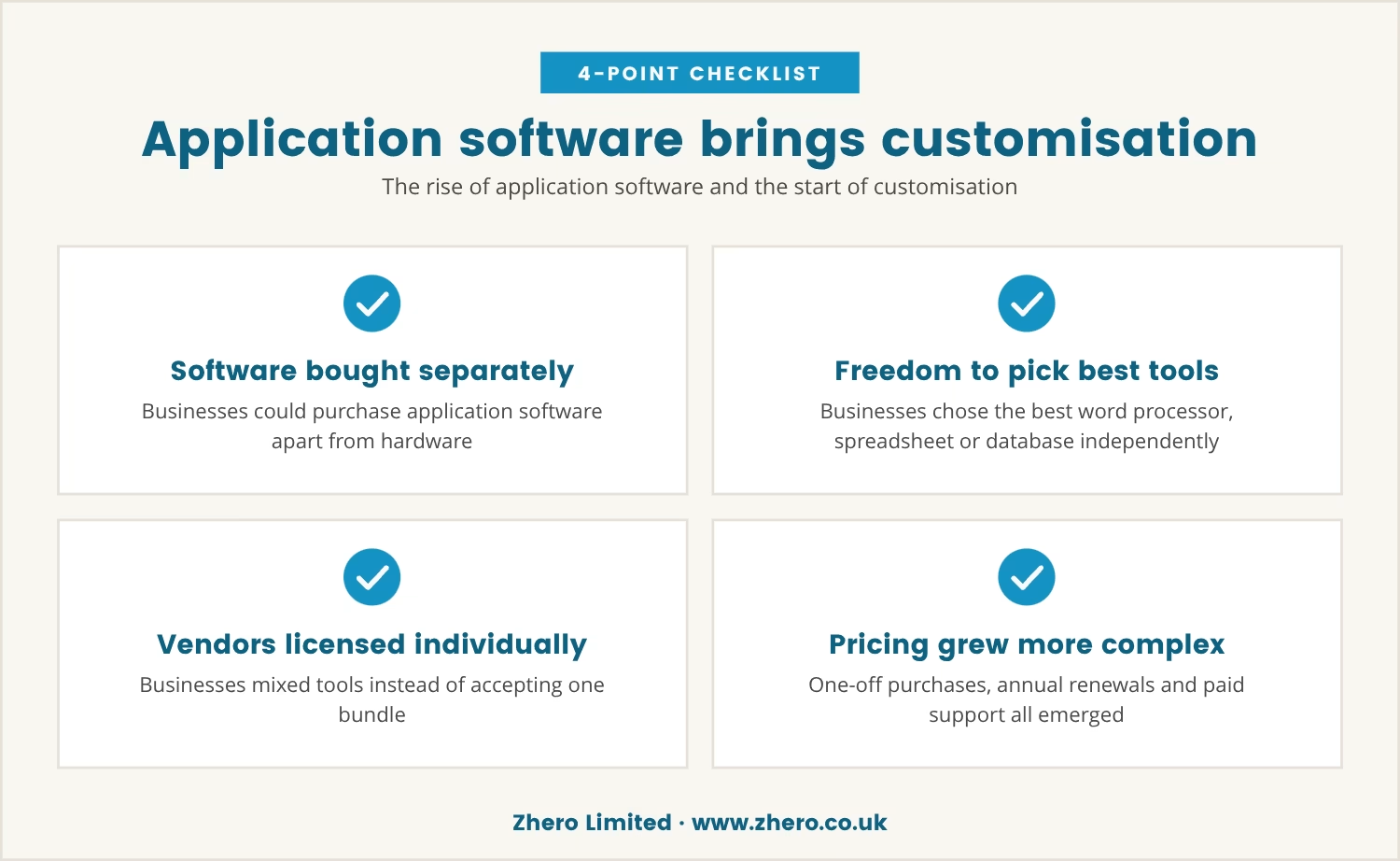
The next era broke that bond between software and hardware altogether. Businesses could suddenly buy application software on its own, and that single change opened the door to customisation and specialisation.
With that freedom came real choice - the best word processor, the best spreadsheet, the best database, picked independently instead of inherited with the machine. Vendors responded by licensing individual products, and businesses started mixing tools rather than accepting one bundle.
Pricing got more complicated as a result: some software sold as a one-off purchase, other software demanded annual renewal, and this era is where paying for support and features - not just the product itself - first took hold.
That's the era showing through whenever you compare application software and wonder why one tool is a simple purchase while another keeps billing you. It's also why software services can be shaped around your business now, instead of forcing a one-size-fits-all deal.
What is software and why do its eras still matter?
People ask what software is, and why its history should affect what they pay today - fair question, and the answer is that every era changed how software gets built, sold, and supported, and those patterns haven't gone away.
The move from bundled system software to standalone application software, for instance, created an entire market for specialised tools on its own. Later, software as a service changed the payment model again, shifting businesses from owning software to subscribing to it.
All of that sits side by side now across London and Greater London: traditional licences next to subscriptions next to hybrids of both. The mix can look confusing, but it also means you get to pick whatever actually fits your business rather than whatever's on offer.
Knowing the history behind these options keeps you from paying for features you'll never touch, or going without support that would've saved you real time and money. It also explains why some software is structured the way it is, even when the reasoning isn't obvious on the surface.
Four eras that still shape software development and pricing
Software development and pricing today is built on four historical eras stacked on top of each other, and each one left its own mark on cost, support and how businesses deal with their tools. Here's how they break down:
1. The bundled era: Software as part of the machine
Software came included with the hardware in this era, so businesses expected it all to work together with little room for choice. Pricing stayed simple, but options stayed limited.
2. The application era: Software as a separate product
Software became its own product once it was sold apart from hardware, letting businesses pick exactly the tools they needed. That choice is what pushed pricing toward more flexible, varied models.
3. The open-source and collaborative era
Open-source software opened the source code to everyone, which let businesses adapt and improve it for their own needs, often cheaper than the alternative. Community support and collaboration became the defining features of this era.
4. The service era: Software as a service (SaaS)
The latest era delivers software over the internet, usually by subscription, so businesses pay for access instead of ownership while the provider handles updates. That model buys flexibility, but it can also mean costs that never stop.
How open-source software changed the rules
Open-source software flipped the usual logic on its head: instead of keeping the source code private, developers put it out in the open for anyone to use, modify or improve.
For businesses, that openness meant lower costs and more control, since you could bend an open-source tool to your own needs or lean on a community instead of a vendor. It also raised a new demand, though - someone in-house now has to manage updates and security that a vendor would otherwise have handled.
Open-source options now cover everything from web browsers to compilers, and plenty of businesses across London and Greater London run a mix of open-source and commercial software to balance flexibility against support.
If you're weighing an open-source option, ask whether your team actually has the skills to manage it or whether you'd need outside help. The right answer depends on what your business is trying to do and what resources you've actually got.
Key factors that influence software pricing today
A handful of factors decide what software costs you and what support comes with it, and understanding each one helps you make a sharper call:
- Development model: Custom-built, off-the-shelf, and open-source each carry a different cost and a different level of support behind them.
- Delivery method: Whether it's software as a service, a traditional licence, or some hybrid of the two changes how you pay and what you actually get for it.
- Support and updates: Some services fold support in, others push it into a separate contract or lean on your own in-house skill.
- Integration needs: The deeper the software has to tie into other systems, the more complex - and the pricier - the setup gets.
- User count: Pricing often tracks the number of users or devices on the account, which matters more as the business grows.
Here's an instinct worth stating plainly: a provider trying to be infinitely custom for every client usually ends up maintaining a dozen slightly different versions of the same problem, and that gets expensive and fragile in ways that only show up later, not upfront.
A standardised delivery model - one set of tools, one minimum security baseline applied across every account - tends to hold up better over time than building bespoke from scratch for each client, if only because support, patching, and security stay simpler when there's one system to maintain instead of twenty variations of it.
That's not the popular thing to say when customisation sells itself, but it's possibly closer to how the economics of running software support actually work. A business wanting something built around it from the ground up, with no shared baseline underneath, is maybe better matched elsewhere - that's not a worse fit, just a different one.
Why understanding these eras helps your business make better choices
Understanding how software's history shapes today's market gives you a genuine edge, because you can spot exactly when a pricing model is a leftover from an earlier era and when a structure is built for real flexibility.
That same understanding keeps you from paying for features you won't use, or going without support that would actually save you time. It also makes comparing software services far easier, because you can see what you're actually looking at and why it's priced the way it is.
For businesses across London and Greater London, where the spread of options is wide, this pattern recognition pays off directly in better deals and fewer costly mistakes. The right choice still comes down to your needs, your team's skills, and where you're trying to get to long-term.

How we help businesses choose software that fits
Most businesses with 5 to 40 users face a confusing mix of software options, each shaped by decades of change. At Zhero Limited, we understand how hard it can be to pick the right tools and support for your size and needs.
If you want to see how we approach software selection and support, or just want a conversation about your current setup, we’re here to help.
Ready to see software’s impact on your IT risk?
Get a risk-free IT trial and a free full cybersecurity audit to see where your business stands and how your software setup affects your security.
Frequently asked questions
How do I know if I need system software or application software?
System software is what runs the machine itself - the operating system, the drivers - while application software is what you actually open to get work done, like a spreadsheet or a word processor. A new computer setup needs both, but day-to-day work mostly happens inside application software.
What is the difference between software as a service and traditional software?
Software as a service runs online through a subscription, so you're paying for access while updates land automatically without you installing anything. Traditional software is bought outright and installed on your own devices, usually as a one-time cost, with updates left to you to manage.
Can open-source software replace commercial software for my business?
Open-source software can genuinely replace commercial tools if your team has the technical skill to manage it, and it usually costs less upfront while allowing deep customisation. Without that in-house skill, you'll likely need to pay for support or training, and some commercial features may simply not exist in the open-source version.
How does software testing affect the reliability of my business tools?
Software testing catches bugs and issues before a release or update ever reaches you, which keeps tools working as expected and cuts the risk of downtime or lost data. Providers with strong testing practices are worth paying attention to wherever your business depends on a system staying up.
What should I consider before switching to a new operating system?
Check compatibility first - will your current applications and hardware still work under the new system? T - then weigh the learning curve for your team and any change in support or security. Planning that out ahead of time is what keeps the switch from turning into unplanned downtime.